TL;DR: Key Financial Indicators of Human Trafficking
Human trafficking is not only a humanitarian crisis—it is also a complex financial crime that relies on the movement of money through legitimate financial systems. Financial institutions play a critical role in detecting trafficking by identifying suspicious financial flows, account activity, and transaction patterns associated with exploitation.
Key financial indicators of human trafficking may include:
- frequent cash deposits or structured deposits below reporting thresholds
- repeated money transfers between unrelated accounts or across international borders
- accounts receiving payments linked to commercial sex or labor exploitation
- rapid withdrawals following deposits, suggesting financial control by another party
- multiple accounts linked through shared identifiers such as a phone number, device, or address
- unusual account activity that does not match a customer’s financial profile
By using transaction monitoring, link analysis, and AML reporting mechanisms such as Suspicious Activity Reports (SARs), financial institutions can help identify human trafficking networks, support law enforcement investigations, and protect potential victims.
Understanding the financial patterns behind trafficking is one of the most effective ways financial institutions can help disrupt modern slavery.
The Shadow Economy: Why Financial Institutions Are on the Front Lines Against Human Trafficking
Imagine a global criminal enterprise generating billions of dollars every year, yet operating largely in the shadows of legitimate commerce. This is the reality of human trafficking, one of the fastest-growing financial crimes in the world. Whether it involves sex trafficking, labor trafficking, or forced labor, trafficking networks depend heavily on the financial system to move and disguise profits derived from exploitation.
Organizations such as FinCEN, the Financial Action Task Force (FATF), and international anti-money laundering (AML) bodies increasingly warn that financial institutions play a critical role in identifying trafficking indicators. Behind nearly every trafficking operation is a complex network of money flows, bank accounts, and financial activities designed to obscure illicit profits and avoid detection.
While law enforcement agencies pursue traffickers directly, banks, fintechs, and payment providers often encounter the earliest warning signs through transaction monitoring and suspicious activity detection. The payments processed each day, from cash deposits and money transfers to account activity linked across devices or phone numbers, may reveal patterns associated with suspected trafficking or money laundering risks.
Financial professionals therefore occupy a unique position among the stakeholders combating modern slavery. They are not simply managing payments or compliance obligations. Through AML programs, suspicious transaction monitoring, and the filing of Suspicious Activity Reports (SARs), they help expose human trafficking networks and disrupt the financial infrastructure that allows exploitation to continue.
This role is increasingly important because trafficking operations often depend on ordinary financial channels. Revenue generated through commercial sex, forced labor, or sexual exploitation must eventually move through bank accounts, payment apps, cryptocurrency platforms, or cross-border transfers. Without the ability to move money, these operations would struggle to scale.
Understanding the financial flows behind human trafficking is therefore essential. By recognizing suspicious transaction patterns, identifying potential victims through unusual account behavior, and reporting trafficking indicators through AML and information-sharing frameworks, financial institutions can help stop exploitation before it spreads further across communities and international borders.
The financial system may unintentionally facilitate trafficking, but it can also become one of the most powerful tools to dismantle it.
Understanding the Financial Footprint of Human Trafficking
Human trafficking rarely occurs in isolation from the financial system. Like other forms of financial crime and money laundering, trafficking generates revenue that must eventually move through legitimate financial channels. Whether through cash deposits, bank accounts, money transfers, or digital payments, these financial flows leave behind patterns that financial institutions can analyze.
For banks and fintechs operating robust anti-money laundering (AML) programs, recognizing these patterns is essential. Regulators such as FinCEN and the Financial Action Task Force (FATF) have repeatedly emphasized that trafficking activity can often be identified through transaction monitoring and the analysis of suspicious transactions linked to exploitation.
In many cases, the financial footprint of trafficking emerges through identifiable typologies — recurring patterns of financial behavior associated with exploitation networks. These typologies can include businesses commonly linked to trafficking risks, such as certain massage parlors, escort services, or labor-intensive operations, where revenue may be generated through sexual exploitation, commercial sex, or forced labor.
From an AML perspective, these activities create measurable money flows and account activity patterns. Trafficking operations frequently involve:
- frequent cash deposits or structured deposits designed to avoid reporting thresholds
- money transfers across accounts or institutions connected to trafficking networks
- unusual financial activities across businesses with high volumes of small payments
- rapid movement of funds across international borders
- the use of digital channels such as cryptocurrency platforms to obscure the origin of funds
These patterns may not immediately confirm trafficking, but they often trigger trafficking indicators within transaction monitoring systems.
Importantly, financial institutions may also encounter signals linked to victims of human trafficking themselves. Victims’ accounts can show unusual financial behavior, such as deposits or withdrawals that do not align with the individual’s employment profile, frequent third-party transfers, or account activity controlled by another person.
When these indicators appear, financial institutions play a crucial role in escalating concerns through internal AML procedures. This may involve filing Suspicious Activity Reports (SARs) or collaborating with law enforcement, NGOs, and other stakeholders engaged in combating trafficking and protecting potential victims.
In some cases, financial intelligence generated by banks has helped authorities identify trafficking networks and connect cases across multiple institutions. Organizations such as the National Human Trafficking Hotline also rely on financial intelligence and information sharing between stakeholders to identify suspected trafficking activity and support investigations.
Understanding these financial typologies and money laundering risks is therefore a critical step in disrupting trafficking operations. By analyzing financial flows, suspicious transactions, and account activity patterns, financial institutions can help reveal the economic infrastructure that sustains human trafficking, and ultimately help dismantle it.
The Exploiter’s Playbook: How Traffickers Move Money
Human trafficking is not only a human rights violation—it is also a sophisticated financial operation. Like other forms of money laundering and organized financial crime, trafficking networks depend on carefully structured financial flows to move profits while avoiding detection.
Traffickers understand that the financial system is both a necessity and a risk. The money generated through commercial sex, sexual exploitation, or forced labor must eventually pass through legitimate channels—bank accounts, payment platforms, money transfers, and sometimes cryptocurrency exchanges. To reduce the chance of detection, traffickers often rely on established money laundering typologies that disguise the true source of funds.
One common method involves structuring deposits to avoid reporting thresholds. Instead of depositing large sums at once, traffickers may make repeated cash deposits in smaller amounts across multiple accounts or institutions. These deposits may be tied to businesses that appear legitimate on the surface but are used to conceal exploitation, such as certain massage parlors, escort services, or labor contractors connected to trafficking operations.
Traffickers may also move funds through complex money flows that involve multiple intermediaries. This can include transfers between seemingly unrelated accounts, rapid withdrawals following deposits, or repeated money transfers across international borders. In some cases, funds are routed through digital assets such as cryptocurrency, which traffickers may perceive as offering greater anonymity.
Another tactic involves using victim-controlled bank accounts. Victims may be forced to open accounts or receive deposits that traffickers later withdraw or transfer. From a financial institution’s perspective, this may appear as unusual account activity, where deposits are quickly followed by withdrawals or transfers to another individual connected to the trafficking network.
These financial behaviors often create detectable patterns within transaction monitoring systems. For example, institutions may observe accounts that receive payments associated with commercial sex or sex acts, followed by rapid transfers to other accounts or prepaid instruments. Similarly, accounts linked to forced labor operations may show payroll deposits immediately withdrawn or transferred under the control of a trafficker.
When these patterns emerge, they often fall into broader trafficking typologies recognized by regulators and law enforcement. Agencies such as FinCEN and FATF have emphasized that these financial patterns may indicate suspected trafficking or related money laundering risks, particularly when combined with other suspicious indicators.
For financial institutions, recognizing the exploiter’s playbook is essential. Traffickers rely on financial systems to sustain their operations. But the same financial data that enables these transactions can also reveal the hidden structure of human trafficking networks.
By analyzing money flows, suspicious transactions, and patterns of account activity, financial institutions can help expose the financial infrastructure that supports exploitation—making it harder for traffickers to operate undetected.
The Victim’s Reality: Financial Indicators of Control
While traffickers attempt to conceal illicit profits, the financial behavior of victims of human trafficking often reveals a different pattern—one shaped by coercion, restricted autonomy, and financial control.
From the perspective of financial institutions, victims’ financial activities and account activity may reflect the conditions under which they are being exploited. These signals can appear in accounts tied to individuals involved in sex trafficking, labor trafficking, or forced labor, where traffickers exert direct control over earnings and financial access.
For example, victims may have bank accounts opened in their name but controlled by another individual. Financial institutions may observe deposits linked to income—such as payments associated with commercial sex or labor-intensive work—followed by rapid withdrawals or transfers to another party. In some cases, funds are moved through multiple intermediaries before reaching the trafficker, creating a trail of suspicious activity that can be detected through monitoring systems.
Another common indicator is the absence of normal financial autonomy. Victims’ accounts may show repeated transactions where wages are deposited but immediately withdrawn in cash or transferred elsewhere. This pattern may suggest that the individual has little control over their own finances, a hallmark of exploitation in many trafficking situations.
Victims may also exhibit signs of financial instability linked to coercion. Accounts might show frequent overdrafts, numerous small withdrawals for basic necessities, or erratic financial activities that do not align with the individual’s employment or living situation. In labor trafficking cases, payroll deposits may appear in an account but are quickly removed by someone else connected to the exploitation network.
From an AML and transaction monitoring perspective, these signals are important because they can reveal potential victims within broader trafficking networks. When financial institutions identify unusual patterns of account control or suspicious transaction flows, those signals can help investigators connect activity across accounts, businesses, or geographic locations.
In some cases, these indicators lead to the filing of Suspicious Activity Reports (SARs) that support investigations by law enforcement. Financial intelligence gathered through banks has helped authorities identify trafficking operations, trace money flows across international borders, and uncover networks involved in both human trafficking and related financial crimes.
Financial institutions also play an important role in information sharing with stakeholders, including regulators, NGOs, and organizations that support victims. Groups working directly with survivors often rely on financial intelligence to understand how trafficking operations function and to identify individuals who may need assistance.
Recognizing the financial indicators associated with victims of human trafficking is therefore not only a compliance obligation—it is also an opportunity to help disrupt exploitation and support the broader effort to combat modern slavery.
Human Trafficking Red Flags in Financial Transactions
Detecting human trafficking through financial activity often begins with recognizing patterns that fall outside normal customer behavior. Regulators such as FinCEN have emphasized that trafficking activity frequently appears through combinations of suspicious transactions, unusual account activity, and atypical financial flows.
While no single transaction confirms trafficking, certain trafficking indicators may signal the need for deeper investigation through transaction monitoring systems and AML review processes.
Below are several financial red flags commonly associated with trafficking operations.
Suspicious Account Activity
Accounts connected to trafficking networks may show unusual patterns that suggest outside control or illicit activity.
These indicators can include:
- accounts receiving frequent cash deposits with no clear business purpose
- multiple bank accounts opened using slight variations of personal information
- accounts opened or accessed by individuals who appear to be under duress or accompanied by a controlling party
- repeated deposits followed by immediate withdrawals or transfers
Financial institutions may also observe multiple accounts linked by shared identifiers such as a phone number, device ID, email address, or physical address. These connections can reveal hidden relationships between accounts that initially appear unrelated.
Suspicious Transaction Patterns
Certain transaction flows can also indicate money laundering risks linked to human trafficking networks.
Examples include:
- frequent money transfers between unrelated individuals or businesses
- high volumes of transactions moving funds across international borders
- repeated purchases of prepaid cards, gift cards, or money orders
- rapid transfers of funds between accounts designed to obscure the origin of payments
In some trafficking cases, institutions may observe payments linked to commercial sex or other exploitation activities, followed by immediate transfers that move funds away from the originating account.
Behavioral Signals Associated with Financial Transactions
Although financial data provides strong indicators, behavioral observations may provide additional context for investigators.
Front-line staff or compliance teams may observe:
- customers who appear nervous, withdrawn, or reluctant to speak independently
- individuals accompanied by someone who answers questions on their behalf or controls the transaction
- customers who provide inconsistent information regarding employment, residence, or business activities
These signals should never be interpreted in isolation. However, when combined with unusual financial activities or suspicious transactions, they may help institutions identify potential victims or suspected trafficking operations.
Escalation Through AML Reporting
When these indicators appear, financial institutions are responsible for escalating concerns through their anti-money laundering (AML) procedures.
This typically includes filing Suspicious Activity Reports (SARs) that provide financial intelligence to regulators and law enforcement agencies investigating trafficking and related financial crimes.
SARs often serve as a critical tool for connecting cases across institutions and jurisdictions. A single report may help investigators identify broader human trafficking networks, trace money flows, or uncover links between financial accounts and trafficking operations.
For financial institutions, recognizing and reporting these indicators through transaction monitoring and AML compliance frameworks is one of the most effective ways to disrupt trafficking activity.
How Financial Institutions Can Detect Human Trafficking Through Transaction Patterns
Detecting human trafficking networks requires more than identifying isolated suspicious transactions. Trafficking operations typically involve multiple actors, accounts, and financial channels. As a result, financial institutions must analyze transaction patterns and financial flows across accounts and entities, rather than focusing on single events.
Modern transaction monitoring systems play a central role in this process. These systems analyze account activity and financial behavior to identify anomalies that may signal suspicious activity or money laundering risks. By monitoring deposits, withdrawals, transfers, and payment patterns, financial institutions can detect activity that may be associated with suspected trafficking operations.
For example, institutions may identify patterns such as:
- multiple bank accounts connected through shared identifiers such as a phone number, device ID, or address
- repeated money transfers between individuals or businesses with no clear economic relationship
- rapid movement of funds through several accounts designed to obscure the financial flows behind exploitation activities
- accounts that show recurring payments tied to businesses associated with known trafficking typologies
When these patterns emerge, investigators can analyze the relationships between accounts to determine whether they may be part of a broader human trafficking network.
Financial institutions also play a critical role in coordinating with other stakeholders involved in combating trafficking. Through AML frameworks and regulatory reporting mechanisms, institutions may share information with law enforcement agencies, regulators, NGOs, and other financial organizations working to identify trafficking activity.
In many jurisdictions, information sharing between institutions has become an increasingly important tool for identifying networks that operate across multiple banks or payment platforms. Because trafficking operations frequently move money across institutions and international borders, collaboration can help investigators connect suspicious activity that might otherwise appear unrelated.
When suspicious transaction patterns are identified, financial institutions escalate concerns through their AML processes, including filing Suspicious Activity Reports (SARs). These reports provide critical financial intelligence that helps authorities trace money flows, identify trafficking typologies, and investigate networks involved in human trafficking and related financial crimes.
By analyzing financial flows, suspicious activity, and transaction patterns across accounts, financial institutions can help expose the economic infrastructure that supports trafficking. This ability to detect and report suspicious financial activity places banks and fintech organizations among the most important partners in the global effort to disrupt modern slavery.
How AI and Link Analysis Help Detect Human Trafficking Networks
As human trafficking networks evolve, so do the financial strategies used to conceal profits and evade detection. Traditional monitoring tools that rely only on static rules can struggle to identify complex trafficking typologies, particularly when traffickers distribute financial activities across multiple accounts, institutions, or jurisdictions.
Modern transaction monitoring technologies, including artificial intelligence and link analysis, allow financial institutions to analyze suspicious activity at a network level rather than focusing only on individual transactions.
Link analysis tools, often powered by graph analytics, like DataVisor’s Knowledge Graph, enable investigators to map relationships between accounts by examining shared data points such as:
- phone numbers
- device identifiers
- email addresses
- IP addresses
- physical addresses
- transaction counterparties
When these connections are analyzed across large datasets, investigators can uncover clusters of accounts that may form part of a broader human trafficking network.
Link analysis is particularly effective at revealing hidden relationships within financial flows. By visualizing how money moves between accounts, investigators can identify central nodes within a network — accounts that receive funds from multiple sources and redistribute them elsewhere. These accounts may represent key facilitators within trafficking operations or individuals responsible for laundering illicit proceeds.
Artificial intelligence can also strengthen AML transaction monitoring by detecting anomalies in financial behavior. Machine learning models analyze historical account activity to identify patterns that differ from normal customer behavior. When unusual money flows or suspicious transactions emerge, these systems can generate alerts for investigators to review.
These capabilities are increasingly important as traffickers adopt new financial channels. In some cases, trafficking networks may use cryptocurrency platforms to move funds across international borders more quickly or to obscure the origin of payments. While digital assets present new monitoring challenges, the underlying financial patterns often remain detectable when institutions analyze transaction relationships and financial flows across networks.
By combining AI-driven analysis, link analysis techniques, and graph-based investigation tools, financial institutions can better identify the money laundering risks associated with human trafficking. These technologies enable investigators to move beyond isolated alerts and instead understand the broader financial structure behind trafficking operations.
As trafficking networks become more sophisticated, the ability to analyze financial relationships at scale will play an increasingly important role in detecting and disrupting exploitation.
What Financial Institutions Should Do to Prevent Human Trafficking
Financial institutions play a crucial role in identifying and disrupting human trafficking networks. While banks and fintech companies cannot investigate trafficking directly, their anti-money laundering (AML) programs and transaction monitoring systems often detect early indicators of exploitation.
By strengthening internal processes and collaborating with external stakeholders, financial institutions can significantly improve their ability to identify suspicious activity linked to trafficking operations.
Train Staff to Recognize Trafficking Indicators
Technology alone cannot identify every trafficking signal. Front-line employees, compliance officers, and investigators must also understand the financial indicators of human trafficking.
Training programs should educate employees about:
- common red flags and suspicious transaction patterns
- behavioral indicators associated with potential victims
- typologies linked to sex trafficking, labor trafficking, and forced labor
- the importance of escalating suspicious activity through internal AML procedures
When staff are equipped with the right knowledge, they are better positioned to identify suspicious situations and escalate them for further review.
Strengthen Transaction Monitoring and Risk Detection
Effective transaction monitoring is one of the most important tools financial institutions have for detecting trafficking activity. Monitoring systems should be configured to identify trafficking typologies and suspicious financial flows, including unusual patterns of cash deposits, money transfers, and account activity associated with exploitation networks.
Financial institutions should regularly review monitoring rules to ensure they reflect evolving money laundering risks and trafficking indicators identified by regulators such as FinCEN and FATF.
Advanced monitoring capabilities — including network analysis and machine learning — can help institutions detect connections between accounts that may reveal human trafficking networks operating across multiple entities or jurisdictions.
File Suspicious Activity Reports and Escalate Concerns
When financial institutions identify potential trafficking indicators, they should escalate the activity through their AML reporting processes. This typically involves filing Suspicious Activity Reports (SARs).
SARs provide critical financial intelligence that helps law enforcement agencies investigate trafficking networks and related financial crimes. In many cases, SAR filings from multiple institutions allow investigators to connect suspicious transactions and identify larger criminal operations.
Timely reporting is essential because financial data may help authorities locate potential victims of human trafficking and intervene before exploitation continues.
Strengthen Collaboration and Information Sharing
Combating trafficking requires coordination among many stakeholders, including financial institutions, regulators, law enforcement agencies, and NGOs working with victims of human trafficking.
In many jurisdictions, information-sharing programs allow financial institutions to collaborate with regulators and law enforcement to identify emerging trafficking patterns. These partnerships help institutions stay informed about evolving trafficking typologies and money laundering risks.
Financial institutions can also support organizations such as the National Human Trafficking Hotline, which collects information about suspected trafficking activity and connects victims with support services.
Through collaboration and responsible information sharing, financial institutions can help strengthen the global effort to combat modern slavery and human trafficking.
Human Trafficking Financial Indicators: Key Questions Answered
What are the financial indicators of human trafficking?
Financial indicators of human trafficking often appear as unusual account activity, suspicious transactions, or irregular financial flows. Common trafficking indicators include repeated cash deposits below reporting thresholds, frequent money transfers between unrelated accounts, and rapid withdrawals following deposits. These patterns may signal money laundering risks or financial exploitation connected to trafficking networks.
How do financial institutions detect human trafficking?
Financial institutions detect trafficking by using anti-money laundering (AML) programs, transaction monitoring systems, and link analysis tools to analyze suspicious activity. By examining financial flows, account relationships, and transaction patterns, investigators can identify clusters of accounts that may be associated with human trafficking networks, forced labor operations, or commercial sex exploitation.
What are common red flags of human trafficking in financial transactions?
Common red flags include frequent cash deposits, repeated money transfers across international borders, and accounts receiving payments linked to commercial sex or labor exploitation. Other indicators include multiple accounts connected through the same phone number, device, or address, as well as unusual account activity that does not match a customer’s financial profile.
What is forced criminality in human trafficking?
Forced criminality occurs when traffickers compel victims of human trafficking to participate in illegal activities such as fraud, theft, or financial scams. Victims may be forced to open bank accounts, conduct money transfers, or participate in money laundering activities. These actions may appear as suspicious financial activity but often reflect coercion rather than intentional criminal behavior.
Why are financial institutions important in combating human trafficking?
Financial institutions play a critical role in combating trafficking because many trafficking operations rely on the financial system to move profits. By identifying trafficking indicators, monitoring suspicious activity, and filing Suspicious Activity Reports (SARs), banks and fintech organizations provide financial intelligence that helps law enforcement disrupt trafficking networks and protect victims.
What should financial institutions do when they detect trafficking indicators?
When trafficking indicators are identified, financial institutions should escalate concerns through their AML compliance processes, investigate suspicious activity, and file Suspicious Activity Reports (SARs) where appropriate. These reports provide valuable financial intelligence to law enforcement, regulators, and other stakeholders investigating suspected trafficking and related financial crimes.
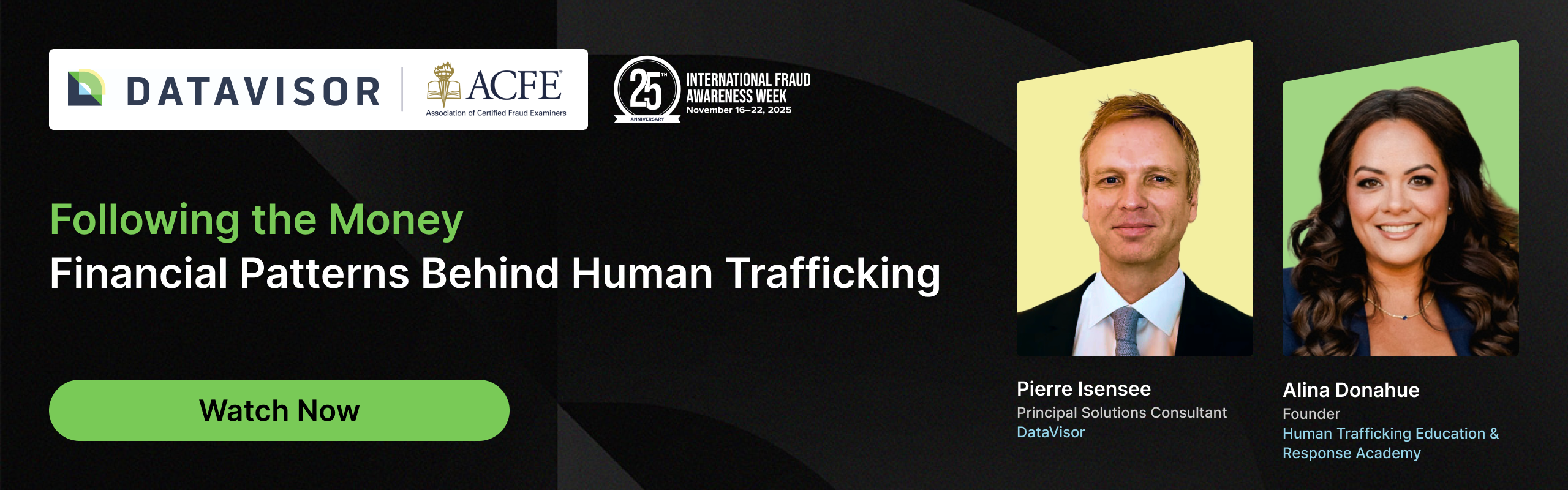
To learn more watch the webinar featuring Alina Donahue and Pierre Isensee: Following the Money: Financial Patterns Behind Human Trafficking