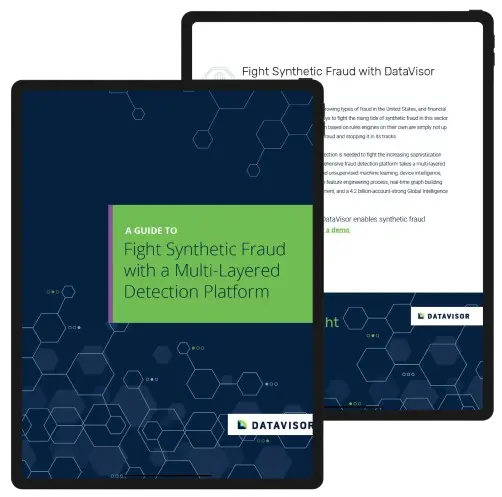
Fight Synthetic Fraud with a Multi-Layered Detection Platform

What’s inside?
Download the guide to learn:
- What synthetic fraud is, and why it’s so difficult to detect
- How synthetic identities are created
- 6 common characteristics of synthetic fraud
- How a multi-layered approach can protect your organization
Introduction
The most damaging threats are the ones you don’t see coming. For financial institutions, synthetic fraud falls firmly into that category.
The Federal Reserve and additional McKinsey research have identified synthetic fraud as one of the fastest-growing types of financial fraud in the United States, with an estimated impact of $6 billion in annual losses.
What makes synthetic fraud so threatening is that most traditional fraud tools fail to detect it. Fraudsters can fly under the radar for months or even years before they “bust out” by suddenly maximizing their available credit and refusing to repay it.
A report by ID Analytics found that models designed to detect traditional fraudulent activity missed as many as 95% of synthetic fraud applicants.
That is a compelling reason for financial institutions to look beyond conventional fraud protection and explore the benefits of a comprehensive fraud platform that can fight synthetic fraud at the gate.
What Is Synthetic Fraud and Why Is It Difficult to Detect?
Synthetic fraud is the fastest growing type of financial fraud in the U.S., resulting in $6 billion in annual losses. To fight synthetic fraud, financial institutions must look beyond conventional methods. Comprehensive fraud platforms that use a multi-layered approach can detect fraud signals across the entire customer account lifecycle, stopping synthetic fraud in its tracks.
Year-After-Year,
the Industry’s Choice




.png)
.png)