The Forrester Wave™ : Financial Crime Management Solutions, Q3 2026 offers an interesting perspective on the current fraud landscape. Looking across the market, Forrester's analysis surfaces how seriously vendors have moved past "AI agent" as a marketing term and whether fraud and AML are still living in separate silos or have finally converged into one operating picture.
Both point to a larger change underway. AI is moving deeper into financial crime operations, from analyzing information to helping teams investigate, build, and act. At the same time, the boundaries around the information available to that AI are expanding.
Together, those shifts offer a useful picture of where financial crime management may be heading next.
AI Agents Are Becoming a Real Platform Capability
What does an AI agent actually do in financial crime? A chatbot can answer a question. An agent should be able to help accomplish a task.
In financial crime management, that distinction matters. Analysts rarely work from a single prompt or data point. They gather evidence, evaluate relationships, investigate activity, determine what matters, and decide what should happen next. Detection teams similarly move from an emerging threat or hypothesis to the rules, features, and strategies needed to address it.
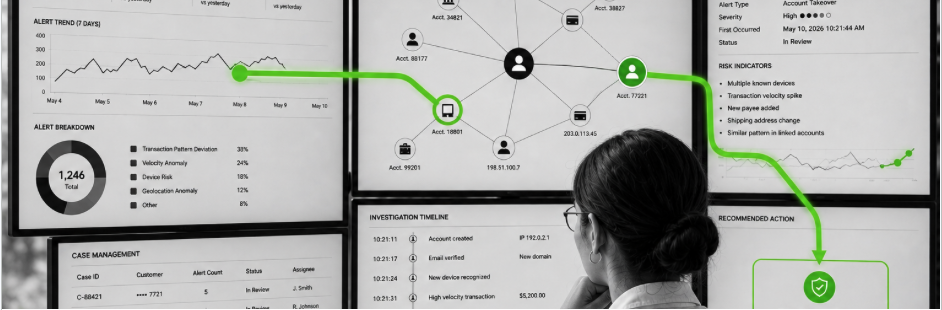
That creates opportunities for AI agents throughout the workflow: synthesizing evidence, guiding investigations, creating and refining detection logic, surfacing relationships, supporting reporting, and helping translate an analyst’s intent into action.
The value, then, is not simply conversational AI. It is reducing the distance between what a financial crime professional wants to accomplish and what the system can execute.
The Category DataVisor Owns: AI Agents
On the AI agent use in the solution criterion, DataVisor received a score of 5.00, the highest possible score. DataVisor’s vendor profile in the Forrester report states: “DataVisor’s powerful data integration has productized schema integrations, while the vendor offers its own AI agent to discover, integrate, and improve the quality of the data it ingests from third-party sources.” On that criterion, AI agent use in the solution, DataVisor's score of 5.00 was among the highest in the evaluation. We believe that score reflects work already in production, and it's the direction we're building toward next. Vera, DataVisor's new conversational AI agent, helps teams translate ideas into execution across the platform, extending the same agent capability Forrester recognized into a broader product experience.
AI Agents in Production
Our customers have shown what this agent-driven approach looks like once it's running against real fraud, not a test environment.
The bar changes when an AI agent moves from a controlled demonstration into a live financial crime environment. Real institutions operate at high volumes, across complex workflows, with changing attack patterns and significant consequences when risk is missed. Analysts need useful results they can understand and act on. New capabilities have to work within the realities of production, rather than adding another layer of work around them.
A top delivery services company processing over six billion packages annually was being hit by coordinated mass-registration attacks: fraudsters using stolen information to create fake accounts, then rerouting packages before anyone noticed. Getting a modern fraud platform integrated fast enough to catch registration fraud at the point of signup (rather than after the damage was done) required onboarding and normalizing data across a massive, high-velocity account base. This resulted in a 60% detection uplift, 40% better reviews with holistic analysis, and $4m in fraud loss savings.
A large federal credit union with more than $3 billion in assets faced a different version of the same problem: disconnected systems that made holistic fraud analysis nearly impossible, and a limited budget that couldn't absorb more manual review work. Rather than a slow, multi-quarter integration, the credit union was up and running with fraud detection in just under two weeks. Once live, DataVisor's Knowledge Graph tool helped investigators visualize connections across accounts and transactions, cutting down false positives and speeding up decisions. The result:
- 300+ hours saved in manual operations
- 36% of risky transactions flagged immediately
Both stories point to the same conclusion: data integration is the foundation detection accuracy, investigation speed, and agent reliability are built on, and it's exactly where DataVisor's 5/5 score in Forrester's AI-agent-use criterion is showing up in production.
These examples point to a useful test for the next generation of AI agents: Can they create measurable value inside the complexity of real financial crime operations?
That is a much higher bar than demonstrating that an agent can complete an isolated task.
Fraud and AML Are Converging Into One Discipline
There is another implication to increasingly capable AI agents: the quality of their work depends in part on the context available to them. That makes the connection between fraud and AML particularly important.
If there's one line in Forrester's report that, in DataVisor’s opinion, captures where the entire market is headed, it's this: vendors are investing in integration between fraud management and KYC/AML components, and in sharing risk-scoring rules and ML models between fraud and AML components. The industry has a name for this convergence now, FRAML, but the concept is simpler than the acronym: fraud and money-laundering risk have always been connected, but the tooling is only now catching up. That disconnect is the daily reality for compliance and fraud teams running parallel systems that don't talk to each other. They duplicate investigative work and lose the cross-signal visibility that would catch what either system alone would miss.
NASA Federal Credit Union lived that reality directly. Separate fraud and AML systems meant data silos, duplicated workflows, and no single view of risk across the institution. Investigators worked on one angle while compliance worked on another, but neither had the full picture. NASA FCU made the shift to a single, unified FRAML platform, consolidating fraud detection, AML transaction monitoring, investigations, and regulatory reporting into one AI-powered environment.
Within nine months of going live they witnessed:
- 42% reduction in AML false positives, while maintaining 100% true positive retention
- 41% reduction in manual review time
- 20% improvement in fraud detection precision
- 90% reduction in SAR filing time
- $200,000 in annual cost savings
False positives are the hidden tax every compliance team pays: hours spent clearing alerts that never represented real risk, at the direct expense of time spent on the alerts that do. Cutting that number nearly in half without losing a single true positive is what convergence is supposed to deliver. Few vendors can show a result like that still holding up at nine months post-launch.
Those outcomes also illustrate the connection back to AI: more connected financial crime intelligence gives both investigators and the systems supporting them a more complete operating picture.
Where This Goes Next
The next phase of AI in financial crime is unlikely to be defined by how many platforms offer an agent. The more meaningful distinction will be how much useful work those agents can perform across the financial crime lifecycle.
We are already seeing that role expand:
- Assist. Explain activity, summarize information, answer questions, and surface relevant evidence.
- Investigate. Follow leads across transactions, accounts, devices, and entities; identify relationships; and help analysts determine what deserves attention.
- Build. Turn an analyst’s intent into rules, features, detection logic, and other executable strategies.
- Act. Move beyond recommendations to help initiate and orchestrate appropriate actions within governed workflows.
- Learn. Bring the results of decisions and investigations back into the process so future detection and decisions can become more informed.
These capabilities will not necessarily arrive in a neat sequence. But they point toward a different relationship between financial crime professionals and their technology. Instead of requiring analysts to translate every idea into a series of manual system interactions, agents can increasingly help translate intent into execution.
Human expertise remains central. Financial crime decisions require judgment, governance, explainability, and accountability. The opportunity for agents is to give that expertise greater leverage.
The 2026 Forrester Wave captures a market in transition. AI agents are becoming an evaluated capability rather than simply an AI talking point. Fraud and AML are becoming more connected. And the conversation around AI is shifting toward what these systems can accomplish in real production environments.
DataVisor received the highest possible score of 5.00 in AI agent use in the solution (alongside a Current Offering score of 3.60, the fifth highest among the 15 vendors evaluated). We believe the results point to something bigger: the future belongs to platforms that can put AI agents to work in production and give them a connected view across fraud and AML.
Five years from now, the distinction may not be between platforms that have AI agents and those that don't. It may be between agents that assist around the edges and agents that have become part of how financial crime teams actually operate.
Ready to see what AI agents and unified FRAML can do in practice? Request a demo or explore DataVisor AI Agents.
___
Forrester does not endorse any company, product, brand, or service included in its research publications and does not advise any person to select the products or services of any company or brand based on the ratings included in such publications. Information is based on the best available resources. Opinions reflect judgment at the time and are subject to change. This report is part of a broader collection of Forrester resources, including interactive models, frameworks, tools, data, and access to analyst guidance. For more information, read about Forrester’s objectivity here.