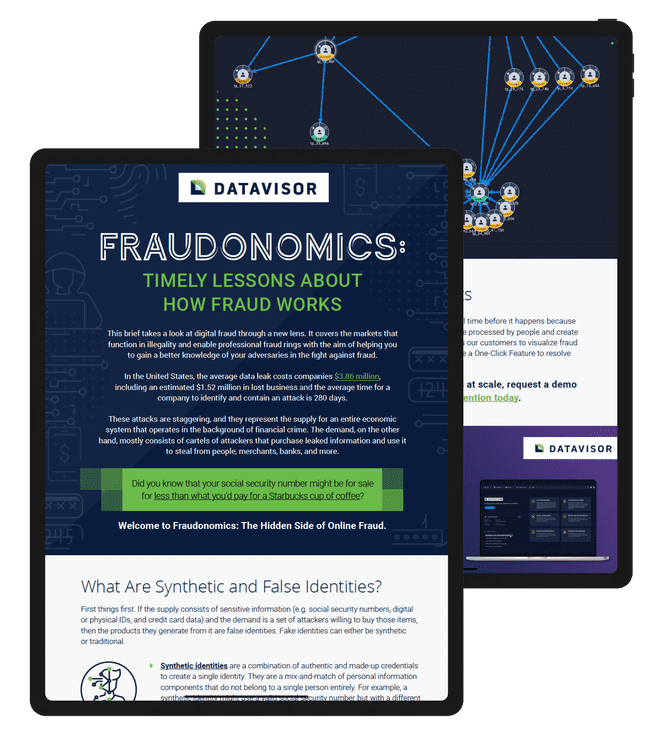
What’s inside?
What we discuss in this executive brief:
- How you can achieve an 80% increase in fraud detection within weeks.
- How the most cutting-edge digital companies have built their fraud strategies on top of identity data to reduce false positives to under 1%.
- How to harness innovation to stay ahead of fraud rings and their coordinated attacks.
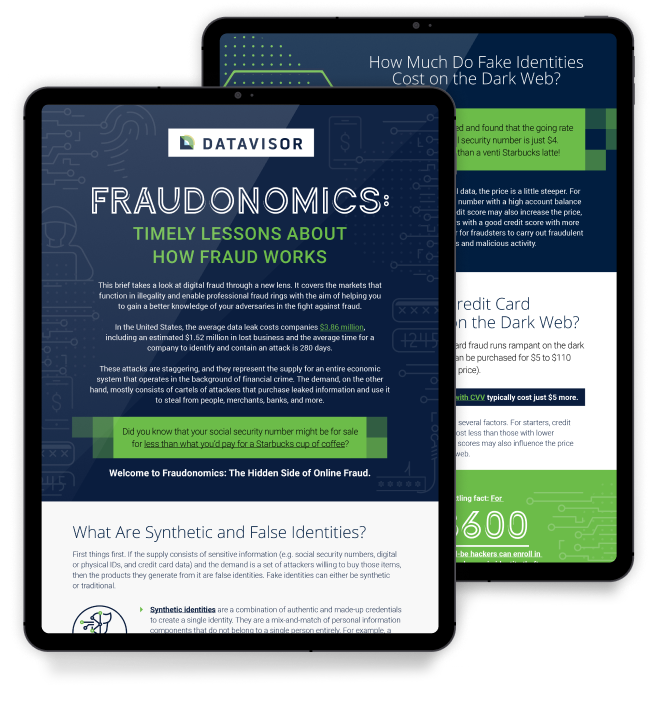
What Are Synthetic and False Identities?
First things first. If the supply consists of sensitive information, such as Social Security numbers, digital or physical identification, and credit card data, and the demand consists of attackers willing to buy those items, then the products generated from them are false identities.
Fake identities can be either synthetic or traditional:
- Synthetic identities combine authentic and fabricated credentials to create a single identity. They mix personal information that does not entirely belong to one person. For example, a synthetic identity might use a valid Social Security number with a different first and last name.
- Traditional false identities use a single person’s compromised information. For example, a data breach may expose someone’s name, address, date of birth, Social Security number, and employment information. An attacker who obtains this information may be able to impersonate the victim in several ways.
How Much Do Fake Identities Cost on the Dark Web?
In this brief, we look at digital fraud through a new lens. We study and describe the markets that function in illegality and enable professional fraud rings in order to provide our readers with a better knowledge of their adversaries. We also provide clear and actionable learnings that you can implement today to become even more successful as a fraud specialist.
In fraud, what you don’t know can definitely hurt you. Does your team have the knowledge to succeed in the new age of digital business?
Year-After-Year,
the Industry’s Choice






.png)
.png)