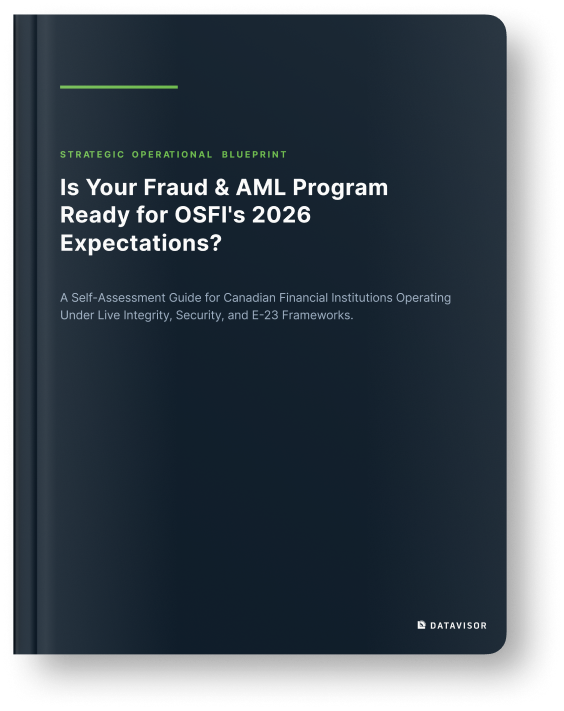
What’s inside?
The transition periods are over. OSFI examiners are no longer reviewing policy documents. They're asking for live operational evidence. And FINTRAC's new monetary penalty regime means the cost of a capability gap has never been higher.
This guide gives your fraud and AML team a clear, honest picture of where you stand across the seven dimensions examiners are now testing from model explainability and vendor governance to STR narrative quality and unified data architecture.
Inside, you'll find:
- The 2026 Canadian Regulatory Convergence Matrix — How OSFI and FINTRAC requirements intersect and create friction for your program
- 7 operational readiness dimensions — What examination-ready looks like for each, in plain language
- A 15-point self-diagnostic checklist — Score your program as Compliant & Automated, Manually Defendable, or Critical Gap
- A scoring guide — So you know exactly where to focus before your next examination
The regulatory environment for Canadian Federally Regulated Financial Institutions (FRFls) has reached a critical inflection point. As of 2026, the transition periods for major supervisory changes have expired. Compliance is no longer judged by the quality of your policy documentation; it is judged by real-time operational execution and auditable proof.
Two primary forces define this shift: OSFI's rigorous enforcement of structural model risk governance, and FINTRAC's heightened focus on immediate tactical effectiveness and monetary penalties. This self-assessment guide maps out exactly where these expectations overlap, how they create friction within fraud/ AML tools, and how your team can accurately quantify its state of audit-readiness.
The 2026 Canadian Regulatory Convergence Matrix
Understanding how individual OSFIguidelines intersect with everyday fraud operations is critical to preventing dual-regulator exposure.

Year-After-Year,
the Industry’s Choice




.png)
.png)