What’s inside?
What we answer in this simple handbook:
- Account fraud basics and its impact on digital firms
- Bots and mass registrations, and how to stop them
- ATO fraud and spotting compromised accounts early
- Credential stuffing attacks and the tech behind them
- Keylogging, session and cookie hijacking, and much more
Account Opening Fraud
Account opening fraud can be defined as any attack or criminal activity that targets the customer onboarding process for the purpose of creating fraudulent or false accounts. In what is also known as account onboarding fraud, criminals use stolen, false, or synthetic identities to gain an entry point and pose as a business’s legitimate customers.
Criminals use false accounts in different ways depending on the type of service they are targeting:
- Social media: Criminals use false accounts to spread disinformation.
- Review sites: Criminals use false accounts to create fake reviews for hire.
- Ecommerce: Criminals use false accounts to order goods with stolen credit cards.
- Cryptocurrency exchanges: Criminals use false accounts to exploit user referral promotions.
- Banks: Criminals use false accounts to launder money.
- Government agencies: Criminals use false accounts to apply for benefits.
Bots and Mass Registrations
As is the case with other forms of fraud, criminal groups often use bots and other advanced technologies in their activities. In account opening fraud, these techniques are used to register accounts at scale and exponentially increase the damage inflicted.
For example, fintech companies may offer new-account incentives or promotions to attract customers who will eventually contribute to revenue. Fraudsters can use bots and batches of false or stolen identities to register thousands of accounts, obtain the promotional bonuses, and then abandon the accounts.
Dormant Accounts and Money Mules
Learn the ins and outs of account protection
Fraud teams handle great amounts of information. With fraudsters constantly innovating and industry terminology that changes rapidly, it is important for them to have access to quick and actionable information to stay ahead in the fight against digital crime.
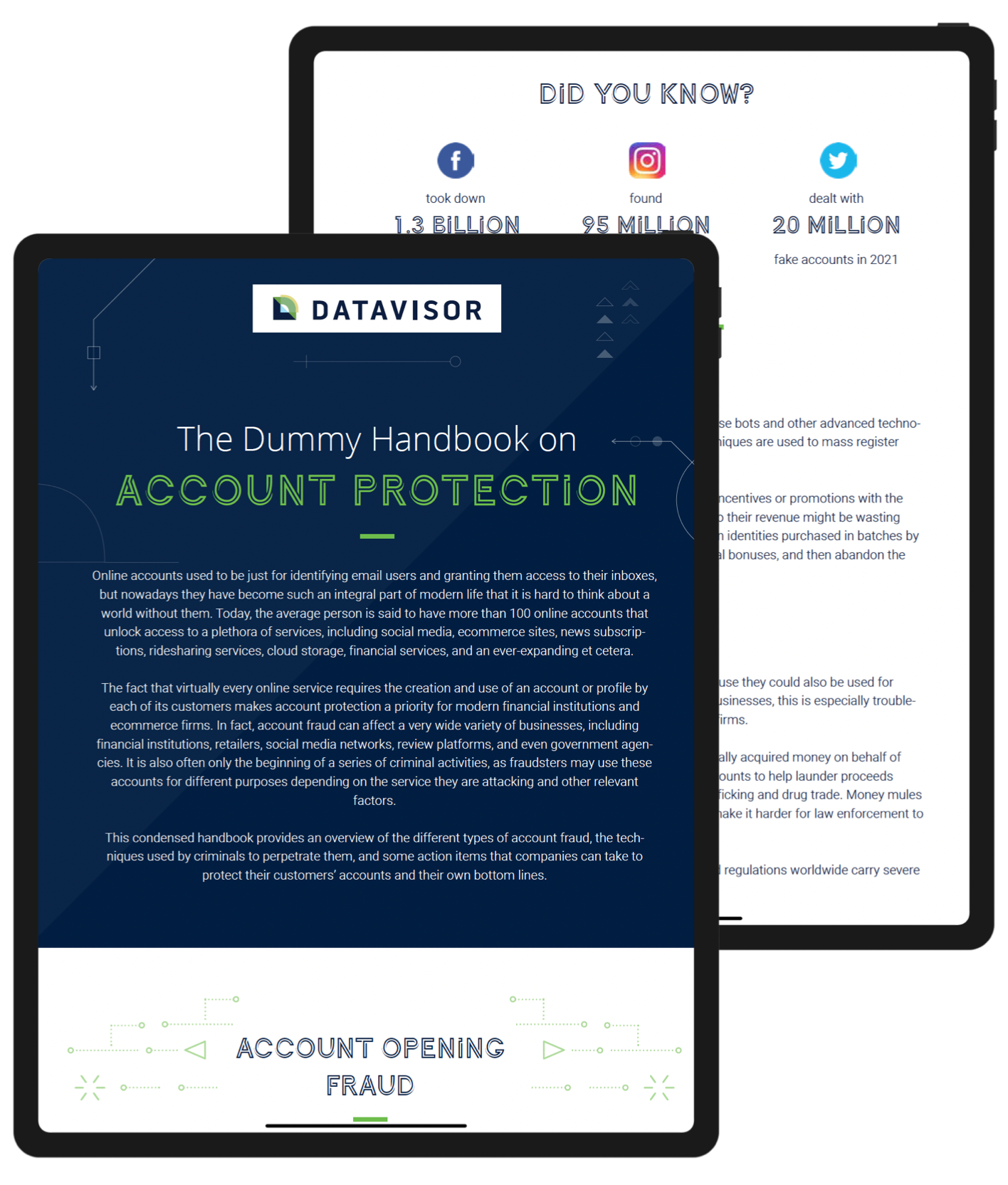
This handbook summarizes the issue of account fraud prevention for financial services, ecommerce, banks, fintechs, social media platforms, and government agencies. It also offers information about the most important related concepts, including ATO attacks, identity theft, phishing, account onboarding fraud, mass registrations, and fake accounts.
Year-After-Year,
the Industry’s Choice




.png)
.png)