Reveal 5 Secrets Behind UML’s Ability to Detect Hidden Fraud Patterns

What’s inside?
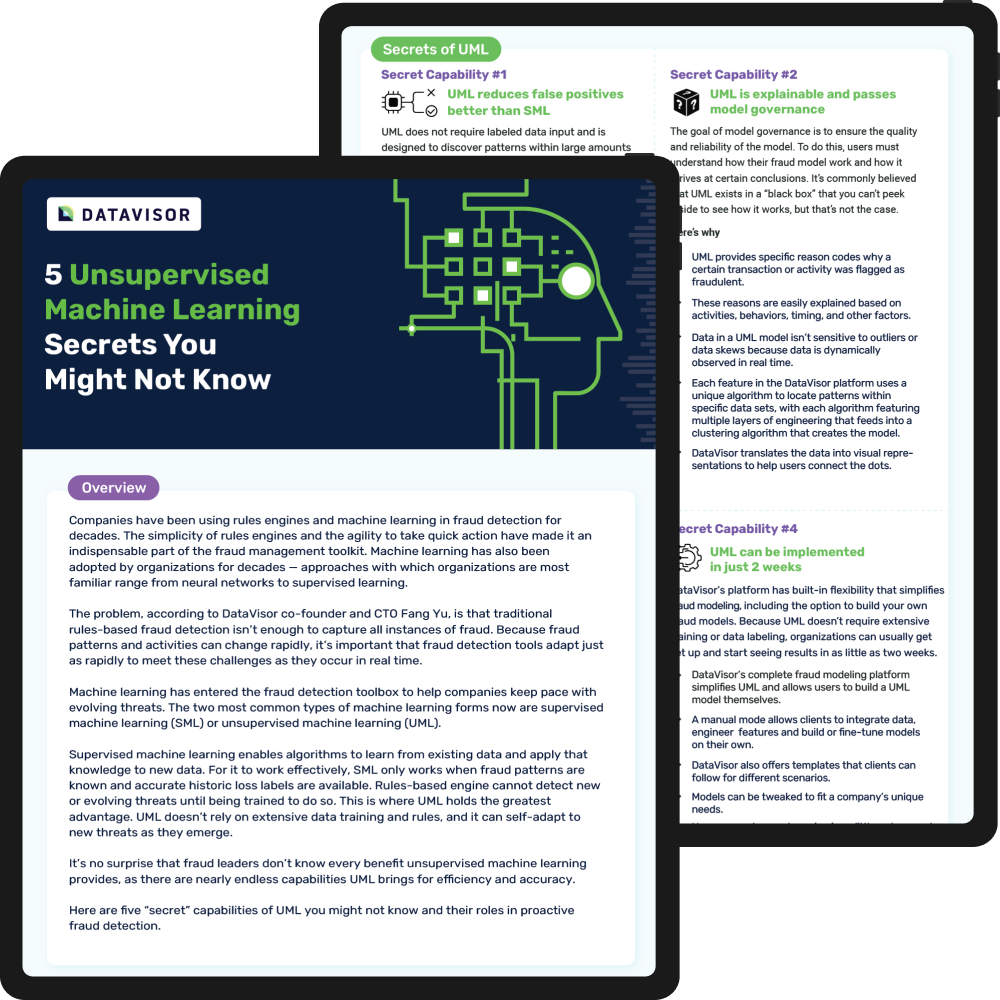
Discover how to leverage unsupervised machine learning to reveal and stop new, sophisticated frauds as they occur.
This guide will show you:
- Ways UML catches new fraud patterns you might not know
- How to leverage UML to reduce false positives
- How UML passes the model governance process
- How to unlock UML’s scalability and agility
Overview
Companies have been using rules engines and machine learning for fraud detection for decades. The simplicity of rules engines and their ability to support quick action have made them an indispensable part of the fraud management toolkit. Machine learning has also been widely adopted, with familiar approaches ranging from neural networks to supervised learning.
The problem, according to DataVisor co-founder and CTO Fang Yu, is that traditional rules-based fraud detection is not enough to capture every instance of fraud. Because fraud patterns and activities can change rapidly, fraud detection tools must adapt just as quickly to address new challenges in real time.
Machine learning has entered the fraud detection toolbox to help companies keep pace with evolving threats. Two of its most common forms are supervised machine learning (SML) and unsupervised machine learning (UML).
Supervised machine learning enables algorithms to learn from existing data and apply that knowledge to new data. For it to work effectively, fraud patterns must already be known and accurate historical loss labels must be available.
Rules-based engines and supervised models cannot detect new or evolving threats until they have been trained to do so. This is where UML holds its greatest advantage. UML does not rely on extensive data training or predefined rules, and it can adapt to new threats as they emerge.
Fraud leaders may not know every benefit that unsupervised machine learning provides because UML offers extensive capabilities for improving efficiency and accuracy.
Here are five capabilities of UML you might not know and the roles they play in proactive fraud detection.
Secrets of UML
Why download this ebook?
As advancements in fraud prevention technology progress, so too do fraudsters’ ever more sophisticated strategies. Cutting-edge technologies like deepfakes help them perpetrate fraud and trick good customers in real-time.
Conventional rules engines and supervised machine learning often struggle to keep pace with these rapidly changing fraud patterns. But fraud teams have a powerful counterpunch in unsupervised machine learning (UML). In fact, it’s so powerful even regular users don’t know some of the best fraud prevention secrets UML holds.
Our handbook, “5 Unsupervised Machine Learning Secrets You Might Not Know,” unveils these hidden advantages in a clear and actionable manner. Download your copy now to explore how incorporating UML into your fraud prevention toolkit can bolster your organization’s defense against fraudulent activities.
Year-After-Year,
the Industry’s Choice





.png)
.png)